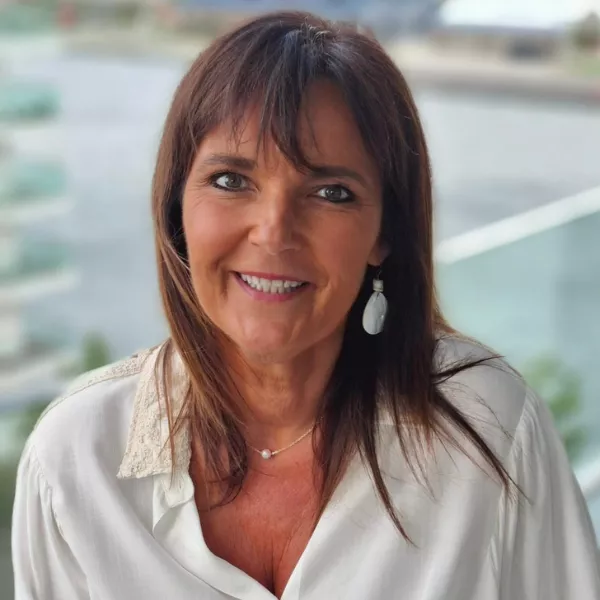
Sandra has been with AWDC since 1988, and graced the front desk for 25 years. Her desk has become the sector's unofficial information point - part helpdesk, part security post, part institutional memory. We sat down with her to talk about the accidental start to her career, the changes she's watched reshape the diamond trade, and her journey in the company.
Can you tell us about your role, and about the company itself?
Sandra Van Vooren: At its core, my job is to welcome people in a friendly way. What began as a simple reception desk - answering phones, signing in visitors - has grown into something closer to an information point for the whole sector. We've even added a helpdesk. It has become basic support for an enormous range of questions, from AWDC's own visitors to newcomers who are pointed our way for anything to do with the sector, including HRD and education matters.
A lot of what we do is filtering: making sure people aren't sent unnecessarily into the building, and that colleagues aren't fielding the same basic questions over and over. Tourists wander in fairly often too, and when I’m training a new colleague, they are amazed at everything I need to be aware of.
People genuinely think of AWDC as the place to go. If you have a question anywhere in the sector, the answer is often, 'just go to AWDC', and it's rewarding to feel like we carry that responsibility well.
The front desk was never just a desk where you check someone in and hand over a badge - if that's all it were, I doubt I'd have lasted this long. What keeps it interesting, even after all these years, is that a question still comes up occasionally that sends me off to find the answer myself. I've always been the type to chase things down with the right department, rather than send a client away or make them wait. In a sense, I'm the first point of contact for anything AWDC, and that scope is genuinely broad.
How did you end up here, and eventually at reception?
Sandra: By accident, more or less. After finishing secondary school in Latin and ancient Greek, I started an economics and IT course at college. I was hopelessly behind within a year, and it was obvious it wasn't going to work. My parents weren't thrilled at the idea of me simply stopping without a job lined up, so I applied here, quite openly telling them I didn't know how long I'd stay.
The job was in the HRD Antwerp lab: administration for the pre- and post-processing of diamonds, and later also placing laser inscriptions in diamonds. I even trained as a lab technician in evening classes alongside my day job. But partway through, I realized a full day behind a microscope, in near-silence, simply wasn't for me.
So I stayed in administration but moved quickly into customer service, first by phone and then at the counters. Years later, restless again, I found myself pushing for more from the company, and I remember telling my manager, quite bluntly, that this was where it would end for me if I wasn't given a chance to grow.
A position opened up at the front desk when badges were first introduced. Before that, we didn't even have security gates like we have now. Once the badges came in, a second person was needed at the desk, and from there it gradually grew into the information point it is today. My knowledge of the diamond lab was a real asset in that role.
I did drift away a couple of times, though never officially. A few months in accounting's customer service taught me quickly that invoices weren't for me. Even a spell helping out in marketing kept getting interrupted by calls to cover reception downstairs, and eventually I realized: this front desk was simply my thing. So I made it official. And I'm still there.
Did diamonds run in the family, or among friends, before you landed here?
Sandra: Not really. My father ran his own tool-sharpening business and, in his later years, worked with diamond boart sharpening diamond tools, which was adjacent to the industry, but not quite inside it. I wasn't consciously aiming for a career in diamonds; I just thought it seemed nice at the time, and assumed I wouldn't stay long.
What's kept you at AWDC, specifically, all these years?
Sandra: This has always simply felt like my spot. I feel at home here, and I've always had a genuinely close team, even if that's thinned out somewhat as the years have gone by. We used to all go out for lunch together, and a lot of us stuck around for the long haul.
Honestly, a good part of my social life has been built here. I'm still in touch with colleagues I started alongside back in 1988. What surprised me most is how open this world actually is, despite how insular it can look from outside: almost everyone here knows everyone, which you'd think would get stale, but it never has. I've rarely dragged myself into work reluctantly, and that's down to the people as much as the fact that everything here has always been properly organized, more than I'd have found in the private sector.
Looking back over the years, is there one memory that stands out?
Sandra: It's genuinely hard to narrow down to one. Prince Filip's visit is an obvious highlight: I sat in the front row for it, and knowing he later became king gives it an extra shine in hindsight. We had all manner of ministers and dignitaries pass through over the years, but that particular visit, with the security operation and everything surrounding it, felt like something else entirely.
If I had to pick a more personal favorite, though, it would be the period I spent working reception alongside my own daughter. She'd been coming in on school holidays since she was fifteen, and at one point she sat right beside me at the desk. It caused its share of chaos, but it was an unforgettable experience.
What advice would you give someone starting out in diamonds, whatever the role?
Sandra: Be ready to work across an extraordinary mix of cultures, each with its own habits and expectations. Learning to say, calmly but firmly, 'I know what we stand for and these are our rules,' has been its own kind of personal growth, and it earns respect, sometimes from exactly the people you'd expect it least from.
And beyond that, build trust: in others, but also in yourself. In this world, trust still counts for almost everything.
Have you seen major shifts in the sector over the years?
Sandra: Enormous ones. Everything has digitalized, which has been especially hard on very small businesses as regulation has piled up. The sector used to run on a handshake, trading happened out on the street, with all the buzz that came with it. Now, almost everything happens behind locked doors, and the instinct has shifted to 'check the website, send an email' instead of face-to-face contact. Cash payments have been restricted in places too. All these new rules have made life genuinely difficult for individual traders and one-man businesses, who don't have the staff that larger companies can dedicate to compliance.
Last question: if you had to pick a different role within the diamond sector: trading, sorting, cutting, what would appeal to you most?
Sandra: It would have to stay communicative, I couldn't manage something solitary, sitting with the same task all day. Trading, combined with travel, would probably suit me best; the one thing I find limiting about reception is being tied to a desk for fixed hours. I have a commercial streak somewhere in me, it’s probably something I picked up from my parents.