
Public Safety License Italy
When traveling to Italy with diamonds for commercial purposes, it is mandatory to hold a valid Public Safety License. To obtain this license—and to carry out commercial activities in Italy more generally—you must appoint a local representative in accordance with Italian public security legislation (TULPS – Testo Unico delle Leggi di Pubblica Sicurezza).
This TULPS representative is responsible for ensuring that your activities comply with local legal and administrative requirements. Failure to appoint such a representative may result in sanctions, including fines and the seizure of goods.


Frequently Asked Questions
Public Safety License FAQ
What is the “public safety license” in Italy?
The “public safety license” is an authorization issued by the Italian Public Security Authorities (through the Questura, the local branche of the Polizia di Stato) required for carrying out activities involving precious goods, such as diamonds.
It does not stem from a Customs procedure but from a national Italian public security law intended to regulate and monitor trade in high-value, sensitive goods and combat fraude and money laundering.
What is the legal basis for this requirement?
The requirement is based primarily on two separate laws:
- Article 705 of the Italian Criminal Code, which requires a license for trading or dealing in precious objects.
- Article 127 of Royal Decree No. 773/1931 (Testo Unico delle Leggi di Pubblica Sicurezza – otherwise known as the ‘TULPS’), which regulates activities involving precious goods;
Together, these provisions make it unlawful to carry out certain commercial activities involving precious goods, such as diamonds, without prior authorization.
Why do I need this license?
You need this license if your activities in Italy are considered “trading in precious items.”
This includes:
- Showing diamonds to clients (either directly or through a trade fair)
- Offering them for sale
- Negotiating transactions
- Any commercial use of the goods
The obligation explicitly also extends to agents, representatives, traveling salesmen, and salesmen that are acting on your companies’ behalf.
Italian authorities consider these activities as regulated and subject to public security oversight.
Does this apply to diamonds specifically?
Yes.
Under Italian law, diamonds are classified as “precious objects.” As a result, any commercial activity involving diamonds may trigger the licensing requirement.
Does this also apply to foreign (EU or non-EU) companies?
Yes.
Even companies established in another EU country must comply when operating in Italy, because public security rules are considered “overriding mandatory provisions” under Italian law.
This means they take precedence over EU free movement principles in this context.
When is the license required, and when not?
The key distinction is between:
a) Mere transport through Italy: no license required
- Transporting diamonds with proper documentation (e.g. invoices)
- No commercial intent on Italian territory only transitory passage
b) Commercial activity on Italian soil: license always required
- Showing goods to clients
- Showcasing goods in trade fairs
- Offering or negotiating sales
- Any form of trading activity
If authorities interpret the activity as commercial, the license becomes mandatory.
Can a foreign company obtain the license without opening an Italian branch?
Yes.
A common solution is to appoint a local representative (TULPS representative) in Italy who takes on the role of a ‘middleman’ and:
- Acts on behalf of the company
- Submits the application to the Questura where he/she lives or where the commercial activities will take place
- Must meet integrity requirements (e.g. clean criminal record)
The Italian TULPS-representative can be:
- An employee of your company
- A commercial representative of your company or agent
- A consultant
However, regardless of the function or title, your TULPS-representative must always be an Italian resident.
Where do I obtain this license?
The license must be obtained from the local Public Security Authority. This means, the Questura (local Headquarters of the Polizia di Stato) in the Italian province where the activities take place or where the local TULPS-representative acting on behalf of the foreign company is residing.
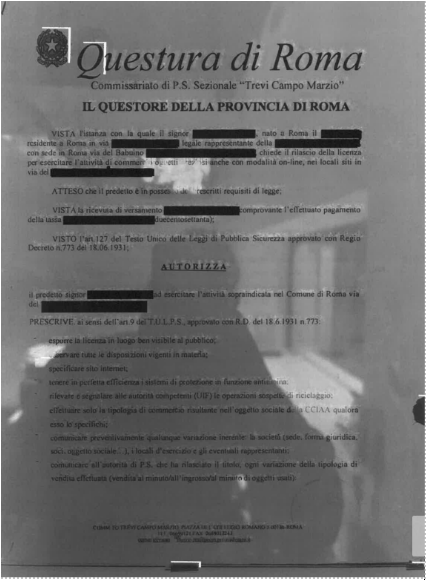
An example of a TULPS-representative with residence in Rome’s license:
How can I find a TULPS representative?
We are currently looking into the most efficient way to establish contact with a TULPS representative. We will update you as soon as we have more concrete information.
Are there simplified procedures (e.g. for trade fairs)?
Yes, a simplified procedure exists and is usually applied by the organizations of international trade fairs (e.g. jewelry exhibitions). The simplified procedure usually consists of:
- A prior notification or application is submitted to the local municipality by the organization
- Organizers providing platforms to upload the necessary documents (‘fast-tracking’)
- Authorization for the duration of the event
However, this is still rooted in the same legal framework.
Recently, there was a lot of talk after the diamonds of an Antwerp-based trader were confiscated in Valenza. Did this really happen? In which context?
Yes, there has been a recent case. Employees of an Antwerp-based trader were stopped by a mobile unit of the Guardia di Finanza while carrying diamonds. Their customs paperwork was in order, but they could not present the required public safety license. The diamonds were seized, and the Prefecture imposed a sanction. The company appealed, but the judge rejected the appeal. He found that the violations of Article 127 TULPS and Article 705 of the Criminal Code were undisputed and confirmed that the seizure and sanction were legally grounded under Italian public security law.
Is this type of enforcement common?
Not systematically – enforcement is more common in Italian regions with a vast majority of diamond and jewellery businesses – but the legal framework is very clear and as such a public license is required in order to be compliant at all times.
Many foreign operators are unaware of this requirement until they are inspected and it is too late.
Is this a customs issue?
No, this is a public security matter.
Is this not a violation of the free movement of goods within the EU?
While this requirement could be seen as a trade barrier for non-Italian companies, it does not technically violate the free movement of goods.
What are the practical risks of non-compliance?
- Seizure (and potentially confiscation) of diamonds
- Administrative sanctions (read: fines)
- Business disruption and reputational impact
What should I do to mitigate risk?
- Consider appointing a local representative
- Obtain authorization from the Questura via this local representative
Why is this the first thing I hear about this?
Probably because:
- This rule is very specific to Italy and non-existent in most other EU member states.
- The enforcement is not uniform in every Italian province and Italian authorities may sometimes apply them inconsistently (or not at all).
- Trade fairs usually take care of this requirement on your behalf.
Who can I contact to help me with the Public Safety License and all things pertaining to it?
- Flanders Investment and Trade: Milaan
- Dirk Smolders: Head Milan office (dirk.smolders@fitagency.com)
- Belgian Chambers:
- Christophe Coulie: Legal affairs managers with specialization in ATA Carnet (ccoulie@belgianchambers.be)
- Voka-Kamer van Koophandel Antwerp-Waasland
- Grant the ATA Carnet
- Jurgen Bogaerts: Head export formalities (jurgen.bogaerts@voka.be) or Jan Haentjens: expert export formalities (jan.haentjens@voka.be)
- VOKA national
- Hendrik Caluwé: expert EU trade (hendrik.caluwe@voka.be)
- Hendrik Caluwé: expert EU trade (hendrik.caluwe@voka.be)
What kind of consultants/experts could I use?
- Lawyers specializing in commercial and customs law (ideally Italian lawyers, as they are likely to have more in-depth knowledge of the national legislation, although local counsel can certainly also be considered).
- Customs brokers or customs forwarding agents with experience handling luxury goods or high-value/precious goods.